Astro Timing
Astrology calculation methodology
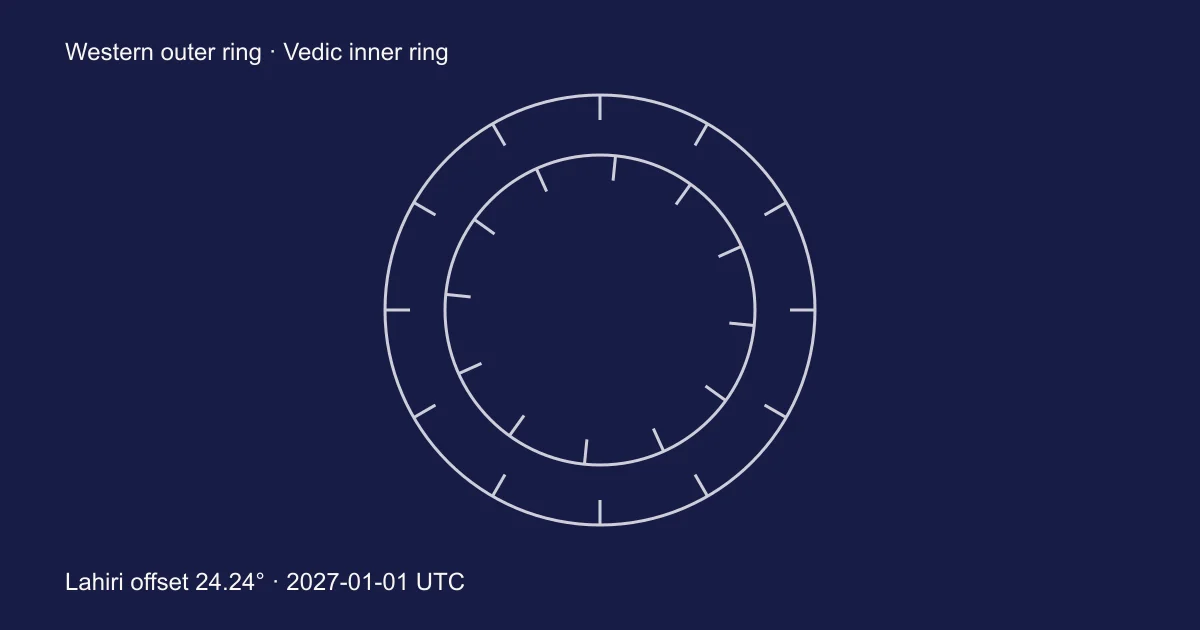
Astronomy Engine supplies geocentric planetary positions; Lahiri ayanamsa supplies the sidereal offset in this preview. Both zodiacs are shown, so you can see where they agree and where they part. Every number comes from one open-source ephemeris, and the full method is published.
Sources
- Brihat Parashara Hora Shastra (BPHS): chapters 36–41, 43 and 77 for yoga patterns; chapters 48, 49 and 53 for planetary periods; house-lord readings use chapter 24 in the brief convention and chapter 26 in the checked corpus.
- Phaladeepika: chapter 6 for yoga patterns.
- Brihat Jataka: chapters 13 and 14 for the cited yoga patterns.
These guides explain traditional chart patterns in our own words. Third-party translations are not reproduced. Classical chapter numbering varies between editions; some chapter references have not yet been verified. See the editorial policy for our review standards.
Calculation checks test the stated planet arrangements, not the predictive accuracy of astrology.
The chart calculator uses Astronomy Engine (MIT), Lahiri sidereal coordinates and whole-sign houses. Manual strength and benefic classifications remain unresolved rather than guessed. Vimshottari dates use a 365.2425-day year, Moon nakshatra balance and UTC half-open intervals; unknown birth time produces an approximate noon timeline.
What are the calculation conventions?
| Quantity | Method and limit |
|---|---|
| Planets | Astronomy Engine (MIT), apparent geocentric ecliptic-of-date Sun–Pluto |
| Sidereal zodiac | Lahiri polynomial offset, validated 1905–2089; not every named ayanamsa |
| Rahu / Ketu | Mean lunar nodes, exactly opposite; not true nodes |
| Lilith | Mean lunar apogee projected to the ecliptic; not an observed body |
| Houses | Placidus diurnal-arc iteration; whole sign; polar Placidus unavailable |
| Vimshottari | Moon nakshatra birth balance; MD/AD; 365.2425-day years |
| Time / location | Offline GeoNames cities15000 coordinates and IANA timezone; Intl resolves historical civil time and daylight saving. Ambiguous or skipped clock-change times require a verified manual offset. Older historical records can differ across timezone database versions. |
| Panchang | Five limbs at local sunrise (upper limb, standard refraction): tithi = Moon–Sun elongation / 12°, nakshatra and yoga from Lahiri sidereal longitudes / 13°20′, karana = half-tithi. Rahu kaal, Yamaganda, Gulika and choghadiya split sunrise–sunset and sunset–sunrise into eighths; Abhijit is the 8th of 15 day muhurtas; planetary hours are unequal twelfths in Chaldean order. Checked against Swiss Ephemeris for 10 dates in 3 cities (names exact, times within 2 minutes; daily snapshot). |
| Good for today | The pin-a-date factors below, evaluated at local noon with the local weekday, for six goals. Start uses the launch list, sign/commit the contract list, rest the reflection list; love, money and travel lists are editorial (classical vivaha, commerce and yatra nakshatras) pending specialist review. Ratings: 26+ strong, 16+ good, 4+ fair, otherwise hold off. Rikta days and eclipses hold off every goal except rest. |
| Moon windows | Disclosed multi-factor scoring of 12:00 UTC snapshots across 35 days. Not a personalized muhurta; no claim of better outcomes. |
How are planning dates scored?
We sample 12:00 UTC on each of the next 35 days and return the three highest scores, breaking ties by earlier date. These are instants, not start/end windows or all-day recommendations. UTC civil weekday is used, not local sunrise weekday. No birth-chart, location, sunrise, lagna or tarabala assessment is included.
- Exclude lunar days 4/9/14 in each half (4, 9, 14, 19, 24, 29), new-moon day 30 (Amavasya), and all global eclipse peaks ±72 hours. Other lunar days receive +10.
- Goal-matching Lahiri lunar mansion: +12, otherwise 0. Lists below are zero-based engine indexes converted here to familiar 1–27 mansion numbers; these are editorial choices pending specialist review, not a claim of universal traditional suitability.
- Reflection: mansions 4,5,7,8,13,17,22,27; Moon/Jupiter weekdays. Creativity: 4,5,13,14,15,21,22,27; Venus/Moon weekdays. Contract/launch planning: 1,4,7,8,12,13,17,21,22,27; Mercury/Jupiter weekdays. Matching weekday +6, otherwise 0.
- Western Moon void-of-course −18; otherwise +4. Definition: no exact applying 0°, 60°, 90°, 120° or 180° aspect to Sun, Mercury, Venus, Mars, Jupiter or Saturn before the Moon leaves its tropical sign. Thirty-minute sampling with root refinement; no outer planets, asteroids or modern alternate definitions.
- Mercury apparent backward motion (retrograde) −20 for contract/launch goals, otherwise 0. This is a review reminder, not advice to delay a required signature.
- Top three reasons are ranked by absolute score contribution. Eclipse and excluded-day filters apply before ranking. No scientific or outcome validation is claimed.
How does the vision board find its chart anchors?
Each life area maps to houses and planets: love to the 5th and 7th houses and Venus; home to the 4th and the Moon; career to the 10th, the Sun and Saturn; money to the 2nd and 11th, Jupiter and Venus; health to the 1st and 6th and Mars; creativity to the 5th, Venus and Mercury; travel to the 9th and 12th, Jupiter and Rahu; learning to the 9th and 12th, Jupiter and Ketu; community to the 11th; peace to the 4th and 12th and the Moon.
- Houses are whole-sign in both zodiacs, counted from the rising sign when a birth time and city are given. Without a birth time we count from the Sun's sign (solar houses); without any birth data, from today's Sun sign. The tool says which it used.
- A window is the stretch when Jupiter or Venus is in one of the area's house signs during the next 24 months, found by daily sampling with the sign change refined to about a minute. Jupiter is preferred because it stays about a year; Venus is shown when Jupiter does not arrive. A window that is already under way needs at least three weeks left.
- With a birth time, the tool also lists Vimshottari sub-periods (antardasha) in the next 24 months whose lord is one of the area's planets or a lord of its houses in the sidereal chart.
- The suggested start day is the highest score under the planning factors above, in the first 35 days of the earliest window.
- Affirmations are built from your own goal in the first person and present tense, plus one line for the feeling you chose. You can swap in a line from our reviewed-draft affirmation sets or rewrite it.
Where do city names and pictures come from?
GeoNames cities15000, downloaded for this preview, CC BY 4.0. We retain city ID, name, coordinates and timezone, not the full record. Coverage favors larger towns; choose a nearby city or manual coordinates when needed. All searches stay local after downloading this site's directory.
Editorial images were generated locally with ComfyUI and Juggernaut XL v9 (SDXL/OpenRAIL++ model terms), with no stock or paid service. The vision board library was generated locally with FLUX.1-schnell (Apache-2.0); every image was checked for faces, people, text and logos before it shipped. Moon discs, zodiac diagrams, retrograde timelines and social cards are original engine/code-generated illustrations. Moon discs use actual phase illumination, not an artistic phase guess.
How accurate is this preview?
A 24-date golden set compares planets, signs, nakshatras and house cusps to a separate Swiss Ephemeris validation process. Swiss Ephemeris is not bundled, served or used by the product. Read the measured report. Accuracy is not proof of astrological outcomes. Boundary cases and unknown birth times need care.
Reviewer: pending. Chiron is omitted rather than supplied from an unvalidated approximation.
How we calculate
Is astrology a guarantee of what will happen?
No. These calculations locate celestial bodies; astrology is a reflection and timing tradition, not evidence of guaranteed health, financial or relationship outcomes.
How are these results calculated?
Positions come from Astronomy Engine, an open-source astronomy library, and are checked against Swiss Ephemeris in our methodology tests. Western readings use the tropical zodiac; Vedic readings subtract the Lahiri ayanamsa. Terms are defined in the glossary.
Next: compare your birth chart, see today's sky, or make a private vision board.