Glossary
Astrology glossary: Western and Vedic terms explained
This glossary explains 60 terms used across the site, from tithi and nakshatra to retrograde, houses and synastry. Each entry starts in plain language and then adds the technical detail. Terms from Vedic astrology (Jyotish) and Western astrology sit side by side, with notes where the two traditions use a word differently.
Terms are grouped by where you'll meet them: the Vedic almanac, the Vedic chart, the birth chart in general, and timing. Each heading's anchor matches the term's slug (for example, /glossary/#tithi).
| Group | Terms |
|---|---|
| Panchang and Vedic timing | 14 |
| Vedic chart | 10 |
| Birth chart, houses and aspects | 26 |
| Timing and the moving sky | 10 |
What is panchang?
Panchang
A panchang is the Hindu almanac: a daily calendar that tells you which lunar day, weekday, nakshatra, yoga and karana are in effect. The name means "five limbs," after those five elements. Because several of them are reckoned from local sunrise, a panchang is calculated for a specific place, and two cities can show different entries for the same date. Families use it to find festival dates, fasting days and times considered good or poor for starting things. On this site the panchang is computed in the sidereal zodiac with the Lahiri ayanamsa.
Tithi
A tithi is a lunar day. Each time the Moon moves another 12 degrees ahead of the Sun, a new tithi begins, so a lunar month has 30 of them. Because the Moon's speed varies, a tithi can last anywhere from about 19 to 26 hours and rarely lines up with a calendar day. The tithi in effect at local sunrise usually names the day in the panchang. Many festivals and fasts, such as Ekadashi, the eleventh tithi, are set by tithi rather than by date.
Paksha
Paksha means a lunar fortnight. Shukla paksha is the bright half, when the Moon is waxing from new to full. Krishna paksha is the dark half, when it wanes from full to new. Each paksha has 15 tithis. Purnima, the full moon, closes the bright half, and Amavasya, the new moon, closes the dark half. Some regional calendars begin the month at the full moon and others at the new moon, so month names can differ by a fortnight between communities.
Nakshatra
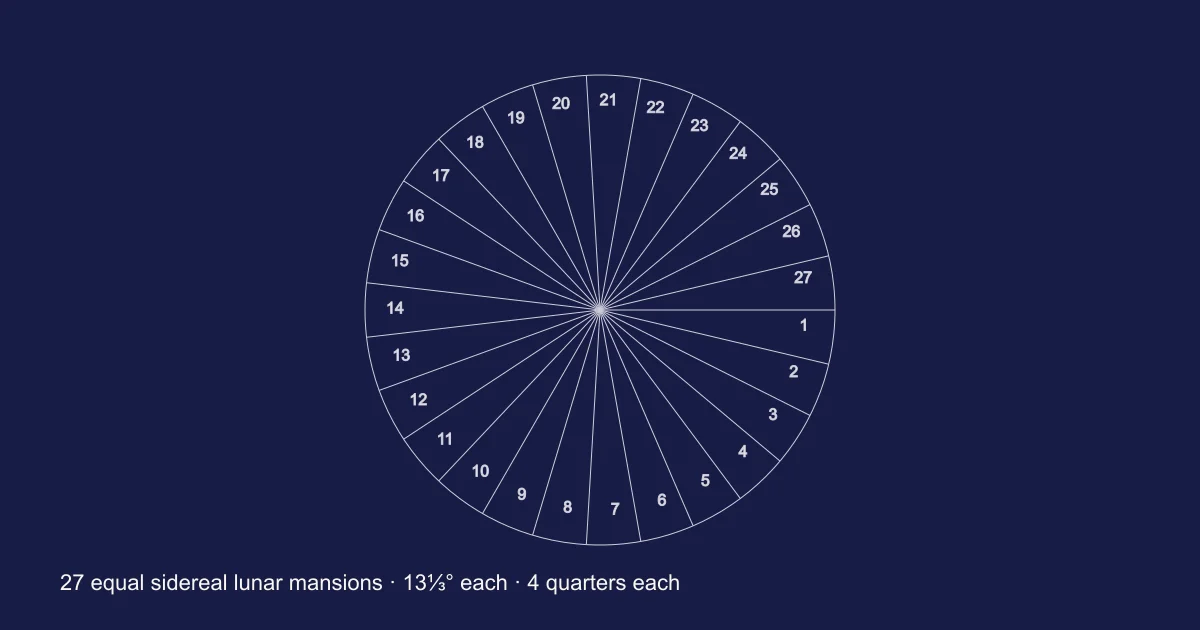
A nakshatra is one of 27 lunar mansions: equal segments of the sidereal zodiac, each 13 degrees 20 minutes wide. The Moon spends roughly a day in each one as it circles the sky. Your birth nakshatra is the one the Moon occupied when you were born, and in Vedic astrology it often says more about you than your Sun sign does. Each nakshatra has a traditional deity, ruling planet and symbol. See the nakshatra guide for all 27.
Pada
A pada is a quarter of a nakshatra, 3 degrees 20 minutes wide. With 27 nakshatras of four padas each, there are 108 padas in the zodiac. Each pada corresponds to one navamsa sign, which is how Vedic astrologers link a birth nakshatra to the D9 chart. In some families the pada of the birth Moon is used to suggest the first syllable of a child's name.
Yoga
In the panchang, yoga is a daily factor calculated by adding the sidereal longitudes of the Sun and Moon and dividing the result into 27 equal parts. Each part has a name, from Vishkambha to Vaidhriti, and a traditional quality; Vyatipata and Vaidhriti are generally avoided for new starts. The same word is used separately for planetary combinations in a birth chart, such as Gajakesari yoga, and for the spiritual practice. Context tells you which one is meant.
Karana
A karana is half a tithi, so there are 60 in a lunar month. There are 11 karanas in all: seven movable ones that repeat through the month and four fixed ones that appear once, near the new moon. Vishti, also called Bhadra, is the karana most often avoided when choosing a time to begin something. Karana is the smallest of the panchang's five limbs and is usually checked last.
Sankranti
A sankranti is the Sun's entry into a new sidereal sign. There are twelve a year, roughly one a month. Two are major festivals: Makar Sankranti, when the Sun enters Capricorn around January 14, and Mesha Sankranti, when it enters Aries around April 14 and the solar new year begins in several regional calendars. Because sankrantis follow the Sun, their dates stay nearly fixed on the Gregorian calendar, unlike festivals set by tithi.
Muhurta
Muhurta has two meanings. It is a unit of time, one-thirtieth of a day and night, or about 48 minutes. It is also the practice of choosing a favorable time to begin something, such as a wedding, a move or a business opening, by weighing the tithi, nakshatra, weekday, rising sign and more. Abhijit muhurta, the one around local midday, is widely treated as generally favorable. Muhurta judges the start of an action; it does not guarantee how the action turns out.
Choghadiya
Choghadiya is a quick timing method popular in western India. It splits daytime and nighttime into eight parts each, about 90 minutes apiece depending on sunrise and sunset, and labels each part by its quality: Amrit, Shubh and Labh are favorable, Char is neutral, and Udveg, Kaal and Rog are avoided for new starts. The sequence depends on the weekday. Many people use it for small decisions, like when to leave on a trip, when a full muhurta would be overkill.
Rahu kaal
Rahu kaal (also rahu kalam) is a period of about an hour and a half each day that tradition treats as unfavorable for starting new work. It is one-eighth of the daytime, measured from local sunrise to sunset, and its position changes by weekday.
| Day | Segment of the day (1-8) |
|---|---|
| Monday | 2nd |
| Saturday | 3rd |
| Friday | 4th |
| Wednesday | 5th |
| Thursday | 6th |
| Tuesday | 7th |
| Sunday | 8th |
Ongoing work can continue through it, and practical deadlines come first.
Hora
A hora is a planetary hour. Vedic and older Western traditions divide the day into 24 horas, each ruled by a planet in the sequence Saturn, Jupiter, Mars, Sun, Venus, Mercury, Moon, starting at sunrise with the lord of the weekday. That is why Sunday begins with a Sun hora and Monday with a Moon hora. In Jyotish, hora is also the name of a divisional chart that splits each sign into two halves.
Janma nakshatra
Janma nakshatra means birth nakshatra: the lunar mansion the Moon occupied when you were born. It is one of the most personal factors in a Vedic chart. It sets the starting point of the Vimshottari dasha sequence, it is the reference for tara bala when choosing good days, and many families use it in naming and in marriage matching. You need an accurate birth date, time and place to find it; the nakshatra calculator does the arithmetic.
Tara bala
Tara bala measures how the day's nakshatra relates to your birth nakshatra. Count from your janma nakshatra to the day's nakshatra and divide into nine groups, called taras: Janma, Sampat, Vipat, Kshema, Pratyari, Sadhaka, Vadha, Mitra and Parama Mitra. The 3rd, 5th and 7th are traditionally avoided for important starts, and the 1st is often treated with caution. It makes a generally good day personal, which is why two people can get different muhurta advice for the same date.
What is lagna in Vedic astrology?
Lagna
Lagna is the Sanskrit word for the ascendant: the sign rising on the eastern horizon at the moment of birth. In Vedic astrology the lagna is the first house, and the signs that follow become the remaining houses in order. It changes roughly every two hours, so it depends on an accurate birth time. Readings usually start with the lagna and its ruler, then move to the Moon. A rising sign calculator can find yours in both zodiacs.
Rashi
Rashi means sign, one of the twelve 30-degree divisions of the zodiac. In everyday Indian usage "my rashi" means your Moon sign in the sidereal zodiac, not your Sun sign. The rashi chart (D1) is the main birth chart. The twelve rashis have the same order and rulers as Western signs: Mesha (Aries), Vrishabha, Mithuna, Karka, Simha, Kanya, Tula, Vrischika, Dhanu, Makara, Kumbha, Meena.
Graha
Graha means "one that seizes" and is the Vedic word for the bodies used in a chart. There are nine: the Sun, Moon, Mars, Mercury, Jupiter, Venus and Saturn, plus Rahu and Ketu, the two lunar nodes. Uranus, Neptune and Pluto are not part of the traditional system, although some modern Vedic astrologers note them. The Sun and Moon count as grahas even though astronomy doesn't call them planets.
Navamsa
The navamsa is the ninth divisional chart, or D9. Each sign is split into nine parts of 3 degrees 20 minutes, and each part is assigned a sign, producing a second chart from the same birth moment. Vedic astrologers use it to judge a planet's underlying strength and to look at partnership and dharma. Because a navamsa sign changes every 13 minutes of clock time on the ascendant, the D9 rising sign is very sensitive to birth time.
Dasha
A dasha is a planetary period. Vedic astrology divides a life into a sequence of periods, each governed by one graha, and reads events and themes through the planet whose period is running. The most widely used system is the Vimshottari dasha, but there are dozens of others. Dashas are layered: a major period (mahadasha) contains sub-periods (antardashas), which contain smaller ones still. They describe themes for reflection, not fixed events.
Vimshottari dasha
Vimshottari is the 120-year dasha system and the default in most Vedic software.
| Graha | Years |
|---|---|
| Ketu | 7 |
| Venus | 20 |
| Sun | 6 |
| Moon | 10 |
| Mars | 7 |
| Rahu | 18 |
| Jupiter | 16 |
| Saturn | 19 |
| Mercury | 17 |
Your starting period is the lord of your birth nakshatra, and the balance left in it depends on how far the Moon had traveled through that nakshatra. A few minutes' error in birth time can move dasha dates by days.
Antardasha
An antardasha is a sub-period inside a mahadasha. Each mahadasha is divided into nine antardashas in the same Vimshottari order, starting with the mahadasha lord's own sub-period, and each lasts in proportion to its planet's share of 120 years. Astrologers name the pair with the major period first, as in "Moon–Rahu": the Moon period sets the backdrop and the Rahu sub-period colors it. A further level, the pratyantardasha, divides each antardasha again.
Ayanamsa
The ayanamsa is the gap, in degrees, between the tropical and sidereal zodiacs. It exists because of the precession of the equinoxes: the March equinox point slides backward against the stars by about one degree every 72 years. In the 2020s the commonly used Lahiri ayanamsa is about 24 degrees. Other versions, such as Raman, Krishnamurti and Fagan-Bradley, differ by up to about a degree, which can change a nakshatra pada near a boundary.
Sidereal
The sidereal zodiac measures signs from the fixed stars. Vedic astrology uses it, as do some Western astrologers. Because the zodiac's starting point is tied to the stars rather than the seasons, sidereal signs sit about 24 degrees behind tropical ones right now, and the gap slowly grows. Practically, most people find their sidereal Sun is one sign earlier than their tropical Sun. Nakshatras, padas and dashas are all calculated in the sidereal zodiac.
Tropical
The tropical zodiac measures signs from the March equinox, the point where the Sun crosses the celestial equator heading north. Most Western astrology uses it. It ties the signs to the seasons: tropical Aries always begins at the March equinox, Cancer at the June solstice, Libra at the September equinox and Capricorn at the December solstice. It does not line up with the constellations of the same names, and it was never meant to.
What is my natal chart?
Natal chart
A natal chart, or birth chart, is a map of where the Sun, Moon and planets were at the moment and place you were born, drawn from Earth's point of view. It shows each body's sign, its house and the angles between bodies. In India it is often called a kundli or janam kundali. The same birth data produces a tropical chart and a sidereal chart; this site shows both. Make yours with the birth chart calculator.
Sun sign
Your Sun sign is the zodiac sign the Sun was in when you were born. It is what most people mean by "my sign" in Western astrology, and it is the only placement you can find from a birth date alone. It is often read as core identity and vitality. In Vedic astrology the Sun sign matters but usually comes after the Moon sign and the lagna. Your tropical and sidereal Sun signs are often different.
Moon sign
Your Moon sign is the sign the Moon was in at your birth. Western astrology reads it as emotional needs and habits; Vedic astrology treats it as the central reference in the chart, called the rashi or janma rashi. The Moon changes sign every two to three days, so you need at least a birth date and approximate time, and a precise time if you were born on a change day. See the moon sign calculator.
Ascendant
The ascendant, or rising sign, is the sign rising on the eastern horizon at the moment of birth. It marks the start of the first house and is read as how you meet the world: first impressions, body and approach. It changes about every two hours, so it needs an accurate birth time. In Vedic astrology it is called the lagna. Your Sun, Moon and ascendant together are often called the "big three."
Descendant
The descendant is the point directly opposite the ascendant, setting on the western horizon at birth. It marks the start of the seventh house and is read as the area of partnership: close relationships, collaborators, contracts and open rivals. Its sign is always the opposite of your rising sign, so a Leo rising has an Aquarius descendant. It describes how you approach one-to-one relationships, not who you will meet.
Midheaven
The midheaven, or MC (medium coeli), is the point of the zodiac highest overhead at your birth, where the ecliptic crosses the meridian. It is read as public life, vocation and reputation. Directly opposite is the IC (imum coeli), linked with home and roots. In house systems like Placidus the MC begins the tenth house; in whole sign houses it can fall in the ninth, tenth or eleventh.
Houses
Houses are the twelve divisions of a chart based on the Earth's daily rotation, starting from the ascendant. Signs describe how something operates; houses describe where in life it shows up. The first house is self and body, the fourth home, the seventh partnership, the tenth work and reputation, and so on around the wheel. Houses depend on birth time and place, which is why two people born on the same day can have very different charts.
House systems
A house system is the method used to divide the chart into twelve houses. Whole sign houses make each sign one house, starting with the rising sign; they are standard in Vedic astrology and in Hellenistic revival work. Placidus, the most common modern Western system, divides by time and produces houses of uneven size. Equal, Koch and Porphyry are other options. Systems can disagree about a planet's house, so check which one a reading uses.
Cusp
A cusp is a boundary: the line where one house or sign begins. "Born on the cusp" means born near the day the Sun changes sign. Astrologically your Sun is always in one sign or the other, not a blend, and the exact time of birth decides which. Some astrologers still read cusp birthdays as carrying a flavor of both signs. House cusps are the starting degrees of each house in quadrant systems like Placidus.
Decan
A decan is a third of a sign, 10 degrees wide, so there are 36 in the zodiac. Each decan has a sub-ruler, and astrologers use them to add nuance: an early-Aries Sun and a late-Aries Sun can be read a little differently. Decans come from ancient Egyptian star-timekeeping by way of Hellenistic astrology. Vedic astrology's version is the drekkana, the third divisional chart (D3).
Element
Element is one of the four temperaments assigned to each sign: fire (Aries, Leo, Sagittarius), earth (Taurus, Virgo, Capricorn), air (Gemini, Libra, Aquarius) and water (Cancer, Scorpio, Pisces). Fire is described as active, earth as practical, air as mental and social, water as emotional. Western and Vedic astrology make the same assignments. Counting the elements across your planets gives a quick picture of a chart's balance. See zodiac elements.
Modality
Modality describes how a sign acts. Cardinal signs (Aries, Cancer, Libra, Capricorn) start things, fixed signs (Taurus, Leo, Scorpio, Aquarius) sustain them, and mutable signs (Gemini, Virgo, Sagittarius, Pisces) adapt. Vedic astrology calls the same groups movable (chara), fixed (sthira) and dual (dvisvabhava), and uses them in choosing times. Each modality contains one sign of each element. See zodiac modalities.
Ruling planet
A sign's ruling planet is the planet traditionally associated with it, also called its lord. Mars rules Aries and Scorpio, Venus rules Taurus and Libra, Mercury rules Gemini and Virgo, the Moon rules Cancer, the Sun rules Leo, Jupiter rules Sagittarius and Pisces, and Saturn rules Capricorn and Aquarius. Modern Western astrology adds Pluto to Scorpio, Uranus to Aquarius and Neptune to Pisces. Your chart ruler is the ruler of your rising sign.
Dignity
Dignity describes how comfortable a planet is in a sign. In its own sign a planet is called domiciled; in its exaltation sign it is strengthened; in the sign opposite its own it is in detriment; and opposite its exaltation it is in fall. Vedic astrology uses similar ideas: own sign, exaltation (uchcha), debilitation (neecha) and moolatrikona. A weak dignity is a technical label for a placement and says nothing final about a person.
Nodes
The lunar nodes are the two points where the Moon's orbit crosses the Sun's apparent path. The North Node is called Rahu in Vedic astrology and the South Node Ketu; Jyotish treats both as grahas. Western astrology often reads the North Node as a direction of growth and the South Node as familiar habit. The nodes move backward through the zodiac, about 18 months per sign, completing a cycle in about 18.6 years. Eclipses happen near them.
Ephemeris
An ephemeris is a table of where the Sun, Moon and planets are on each date, usually at midnight or noon in a reference time zone. Astrologers used printed ephemerides to cast charts by hand; software now computes the same positions, typically with the Swiss Ephemeris. An ephemeris lists positions in the tropical zodiac unless it says otherwise, so sidereal positions need the ayanamsa subtracted.
Aspects
Aspects are angles between planets in a chart, measured along the zodiac. The five major aspects are the conjunction, sextile, square, trine and opposition. Each is read as a kind of relationship between the two planets' themes: blending, cooperating, pressuring, flowing or polarizing. Vedic astrology uses a different, sign-based system called graha drishti, in which every planet aspects the seventh sign from itself and Mars, Jupiter and Saturn have extra aspects.
Conjunction
A conjunction is when two planets sit at roughly the same degree of the zodiac, 0 degrees apart. Their themes blend and intensify each other, for better or worse depending on the planets and the person. A Sun-Mercury conjunction is very common, since Mercury never strays far from the Sun. In Vedic astrology planets in the same sign are said to be conjunct even when they are many degrees apart, a looser rule than most Western astrologers use.
Sextile
A sextile is an angle of 60 degrees, two signs apart. It links signs of compatible elements, such as fire and air, and is read as an opportunity: the planets cooperate when you make an effort. It is considered milder than a trine. Astrologers usually allow a smaller orb for sextiles than for the stronger aspects. A Venus-Mars sextile, for example, is often read as easy chemistry that still needs someone to make the first move.
Square
A square is an angle of 90 degrees, three signs apart. It usually links signs of the same modality and clashing elements, and astrologers read it as tension or friction that pushes for action. Squares are often called challenging, but many astrologers see them as the aspects where people grow the most, because they don't let a pattern sit still.
Trine
A trine is an angle of 120 degrees, four signs apart, usually linking signs of the same element. It is read as ease and natural flow: talents that come without much effort. The risk astrologers mention is complacency, since what comes easily may not get developed. A grand trine is three planets each about 120 degrees apart, forming a triangle in one element.
Quincunx
A quincunx, or inconjunct, is an angle of 150 degrees, five signs apart. The two signs share neither element nor modality, so astrologers read it as an awkward fit that needs ongoing adjustment rather than a clean resolution. It is a minor aspect in most schools, used with a tight orb. Two quincunxes to the same planet from a sextile pair form a pattern called a yod.
Opposition
An opposition is an angle of 180 degrees: two planets on opposite sides of the zodiac. It is read as polarity, two sets of needs pulling in opposite directions that ask for balance. Oppositions often show up in relationships, where one person seems to carry one end of the axis. The full moon is an opposition of the Sun and Moon.
Orb
An orb is how far from exact an aspect can be and still count. If the Sun is at 10 degrees Aries and Mars at 16 degrees Leo, they form a trine with a 6-degree orb. Many astrologers allow about 6 to 8 degrees for major aspects and more when the Sun or Moon is involved, with tighter limits for minor aspects. There is no single rule, and the closer an aspect is to exact, the stronger it is usually considered.
Synastry
Synastry is the comparison of two birth charts to see how two people's placements interact. An astrologer lays one chart over the other and notes the aspects between them, such as one person's Venus trine the other's Moon, and which houses each person's planets fall in. It applies to any relationship, not only romance. Vedic astrology has its own matching method, kuta matching, which scores the two Moon nakshatras. Try the synastry calculator.
Composite chart
A composite chart is a single chart made for a relationship by taking the midpoint of each pair of planets: the midpoint of both Suns, both Moons and so on. Astrologers read it as the relationship's own character, separate from either person. A related method, the Davison chart, uses the midpoint in time and space between two births instead. Both are Western techniques without a classical Vedic equivalent.
What does retrograde mean?
Transit
A transit is where a planet is now, read against your birth chart. When transiting Saturn reaches the sign or degree of your natal Sun, for example, astrologers say Saturn is transiting your Sun. Transits are the main Western timing tool; Vedic astrology calls them gochara and reads them together with the running dasha. They describe themes in the background, and how you use the time is up to you.
Ingress
An ingress is a planet's entry into a new sign. The Moon makes an ingress every two to three days, the Sun about once a month, and Saturn only once every two and a half years or so. Astrologers often mark major ingresses, such as Jupiter or Saturn changing sign, as a shift in collective themes. The Vedic Sun's ingresses are the sankrantis. Tropical and sidereal ingress dates differ by weeks.
Retrograde
Retrograde is the apparent backward motion of a planet against the stars, seen from Earth. Nothing actually reverses; it is an optical effect of Earth overtaking or being overtaken by another planet. Mercury goes retrograde about three times a year for roughly three weeks. The Sun and Moon never do. In Vedic astrology Rahu and Ketu are treated as always retrograde, and a retrograde planet is often read as strengthened rather than weakened.
Station
A station is the point where a planet appears to stop before changing direction. A planet "stations retrograde" when it seems to halt and begin moving backward, and "stations direct" when it halts again and resumes forward motion. Because the planet barely moves for a few days around a station, astrologers often treat those days as the most intense part of a retrograde cycle.
Shadow period
The shadow period is the stretch before and after a retrograde when a planet covers the same degrees it will retrace. The pre-shadow begins when the planet first reaches the degree where it will later station direct; the post-shadow lasts until it passes the degree where it stationed retrograde. Mercury's shadows add roughly two weeks on each side. Many astrologers treat them as a time to finish and review rather than launch.
Void-of-course
The Moon is void-of-course after it makes its last major aspect to another planet in a sign and before it enters the next sign. The void can last a few minutes or more than a day. Western electional astrology traditionally advises against starting important things during it, on the idea that they lose direction. It is a Western technique; Vedic muhurta uses tithi, nakshatra and other factors instead.
Lunation
A lunation is a new moon or full moon, or the whole cycle from one new moon to the next, which averages about 29.5 days. At the new moon the Sun and Moon are conjunct; at the full moon they are opposite. Many people use lunations as monthly checkpoints, starting projects near a new moon and reviewing near a full moon. The site's 2027 moon calendar pages list exact times for each one.
Eclipse
An eclipse happens when the Sun, Earth and Moon line up closely enough for a shadow to fall. A solar eclipse can only happen at a new moon and a lunar eclipse only at a full moon, and only when the lunation falls near the Moon's nodes. That happens in eclipse seasons about every six months. Both traditions treat eclipses as significant; Vedic practice traditionally avoids starting auspicious work during one.
Saturn return
A Saturn return is when transiting Saturn comes back to the position it held at your birth. Saturn takes about 29.5 years to circle the zodiac, so returns come around ages 29, 58 and 88. Astrologers associate the first return with taking stock of adult responsibilities: work, commitments and what you are building. The return period lasts a year or more, since Saturn moves slowly and often crosses the same degree several times.
Solar return
A solar return is the moment each year when the Sun comes back to its exact natal position, usually on or within a day of your birthday. Astrologers cast a chart for that moment and read it as a theme for the year ahead. The chart depends on where you are at your birthday, and some people travel for a preferred solar return chart. It is a Western technique, comparable in spirit to the Vedic varshaphala.
Common questions
Why does this site use two zodiacs?
Western astrology mostly uses the tropical zodiac, tied to the seasons, and Vedic astrology uses the sidereal zodiac, tied to the stars. Showing both lets you compare them instead of guessing which one a reading assumes.
Do I need to know all of these terms?
No. Most pages define the terms they use. Come back here when a word gets in the way.
Why do Sanskrit words have several spellings?
They are transliterated from Devanagari, and there is no single everyday spelling. We use common English spellings in running text and diacritics where a source is quoted.
Keep going
Updated 2026-10-12. Traditional interpretations are not predictions.
How we calculate
Is astrology a guarantee of what will happen?
No. These calculations locate celestial bodies; astrology is a reflection and timing tradition, not evidence of guaranteed health, financial or relationship outcomes.
How are these results calculated?
Positions come from Astronomy Engine, an open-source astronomy library, and are checked against Swiss Ephemeris in our methodology tests. Western readings use the tropical zodiac; Vedic readings subtract the Lahiri ayanamsa. Terms are defined in the glossary.
Next: compare your birth chart, see today's sky, or make a private vision board.